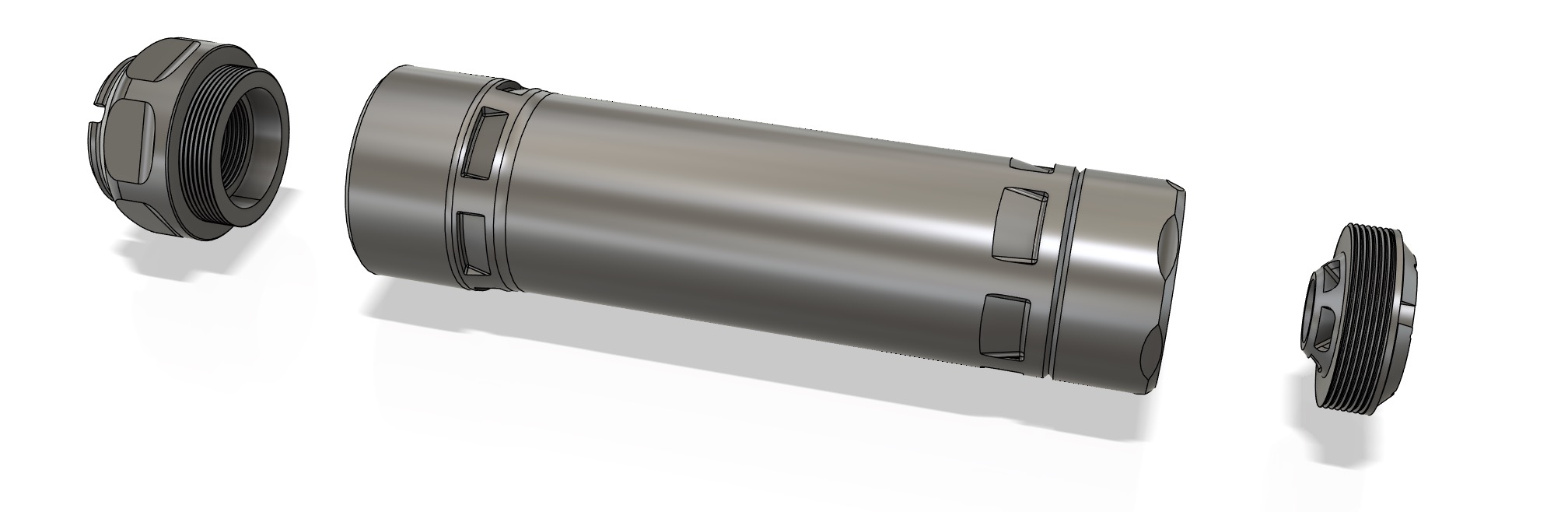
Our four suppressor models are built using direct metal laser sintering in Ti-6Al-4V. That choice is not cosmetic. It changes what the inside of the can can look like, and the inside of a suppressor is most of what makes it work.
The geometry problem
A suppressor slows and redirects hot gas. The tighter you can control the gas path, the more energy the can absorbs before sound reaches atmosphere. Traditional welded stainless steel suppressors stack conical or K baffles inside a tube because those shapes can be machined on a lathe and stacked. They work. They are also a compromise dictated by how metal gets shaped on a two-axis tool.
DMLS removes that constraint. The machine builds the baffle stack layer by layer, 30 to 60 microns at a time, from titanium powder fused by a laser. Geometry that cannot be cut or welded is now producible in one continuous part: scalloped baffles, internal vortex channels, wall thicknesses that change across a single feature, cooling fins that spiral rather than stack.
Titanium, specifically Ti-6Al-4V
Ti-6Al-4V (Grade 5 titanium) is 90 percent titanium, 6 percent aluminum, 4 percent vanadium. It is the alloy most aerospace and medical implant parts use because it has a high strength-to-weight ratio, handles heat well, and does not corrode.
Three properties matter for a suppressor:
- Density. 4.43 g/cc, about 56 percent the weight of stainless steel at the same volume. A rifle can in titanium weighs what the same can in steel weighs with a third of the material removed.
- Service temperature. Ti-6Al-4V holds useful strength past 600 degrees Fahrenheit and will not creep the way aluminum does under sustained fire.
- Thermal conductivity. Titanium runs cool to the touch longer than steel because it moves heat through itself slowly. For a shooter, that means a can you can stage-grab sooner. For the can, it means the outer shell sees less peak temperature.
Monolithic build, no welds
A welded suppressor has at minimum two joints: the baffle stack to the tube, and the end caps to the tube. Those joints are the first places to fail in a blown can. A printed suppressor is one part from muzzle thread to blast baffle. No welds. No brazed joints. No threaded seams inside the gas path to loosen from thermal cycling.
This also changes how we iterate. Switching baffle geometry on a welded can means new tooling, new jigs, new weld fixtures. Switching baffle geometry on a printed can means changing the CAD file and queueing the print.
What printing in-house changes
The OCM mPRINT PRO machine arrives in Southlake in August 2026. Until then, prints run at Impac Systems in Austin on a two-week lead. Once the machine is installed and qualified, four things happen:
- Lead time drops from two weeks to days.
- Iteration cost on baffle revisions drops to near zero.
- We can run small production batches of one-off geometry for evaluators without tooling up an outside vendor.
- We own the full process chain: CAD, print parameters, heat treat, post-processing, test fire.
That last point is the one that matters most for a manufacturer. The company that controls the process chain controls the product.
What this does not mean
DMLS titanium is not automatically better than a well-made stainless steel welded can. It is different, and the differences favor certain use cases. If you want a brick-tough host for abusive full-auto fire at the lowest unit cost, welded stainless is still a good answer. If you want the quietest, lightest, most thermally stable can that current manufacturing can produce, the answer is printed titanium.
We made the call on printed titanium because it lines up with what we are trying to do: build the best version of each product in the catalog, not the cheapest version we can ship.
Our four-model suppressor line covers 6mm / 5.56, 9mm / .36, .308, and .45 / 10mm. Form 3 to dealers runs 1 to 4 days. Form 4 consumer eFile runs 4 to 10 days.