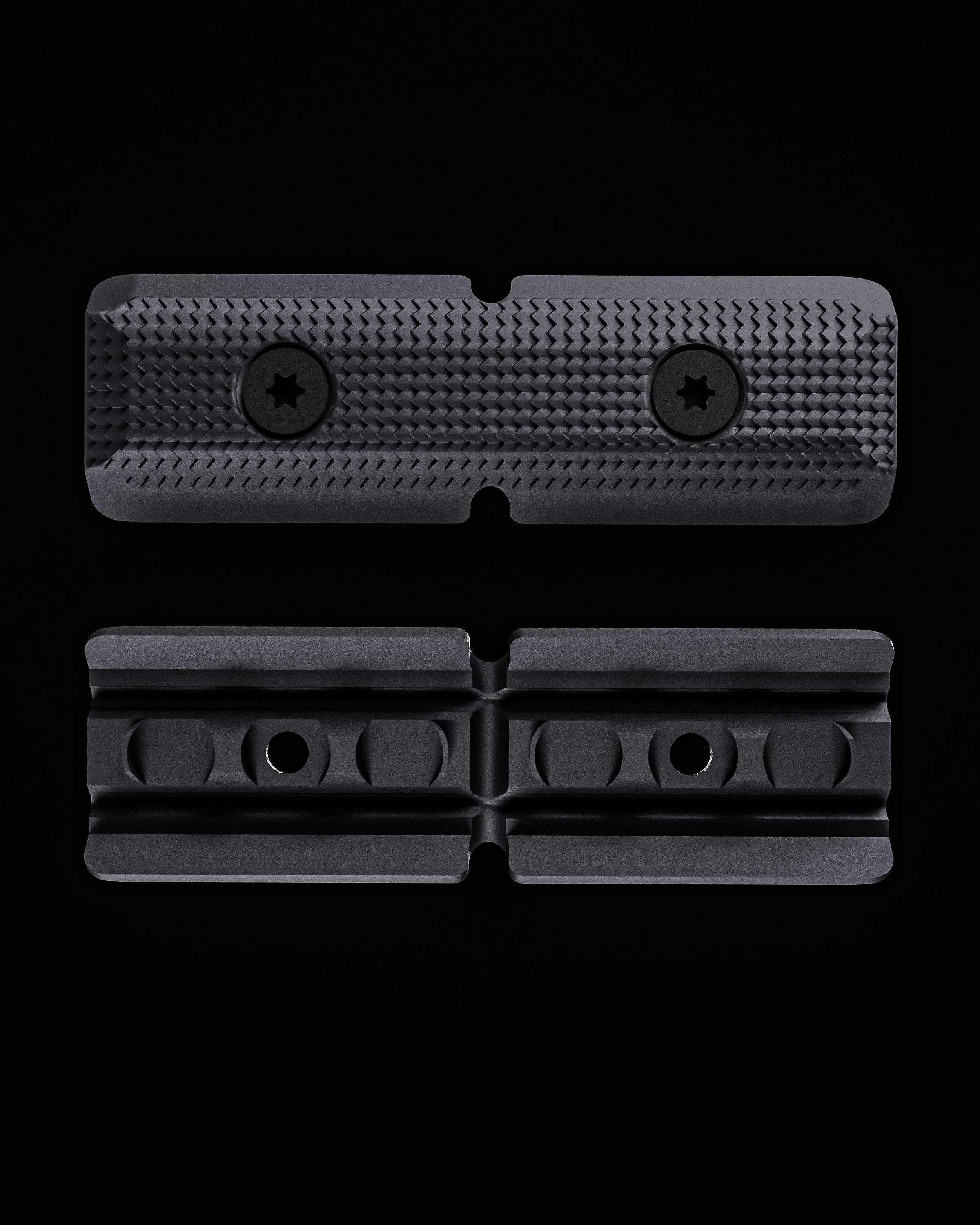
Rail covers are the cheapest, most overlooked part of a build. They change how the gun handles more than most $200 accessories. The reason comes down to three things: how the cover sits in the slot, how thick the wall is, and what the outside edge does to your hand.
The M-LOK slot, briefly
The M-LOK standard defines a through-slot in the handguard with a T-nut that rotates a quarter turn to lock. The slot itself is 7 mm wide by 32 mm long on the standard size. A cover that indexes properly drops flush into the slot profile and grips under a pair of nuts. A cover that does not index properly walks under recoil, and every shooter who has used sloppy covers has felt that.
Three geometries decide whether a cover sits still:
- Nut pocket depth. The T-nut needs room to rotate without bottoming out. Too shallow and the nut will not clear. Too deep and the cover bows under torque.
- Slot-edge fit. The cover's underside has a pair of pads that drop into the long edges of the slot. These should fit with no lateral play. Loose pads allow rotation. Tight pads resist installation.
- End registration. Adjacent covers should sit shoulder-to-shoulder with no visible gap. A 0.2 mm gap looks cheap. A 0.4 mm gap catches sleeves.
Wall thickness is a trade
Thicker walls mean more insulation from a hot barrel nut and more of the grip pattern to hold. They also add stack height, which moves the shooter's hand further from the bore line. Every millimeter of cover wall is a millimeter the support hand sits away from the muzzle.
We tested wall thicknesses from 2.0 mm to 3.5 mm. Under 2.2 mm the cover transmits heat fast enough to force a glove after a mag dump. Over 3.0 mm the handguard starts to feel chunky and the shooter loses the thin-profile advantage of a modern M-LOK rail. We settled on 2.5 mm across all four lengths as the point where heat isolation and grip comfort both still work.
Edge radius: sharp grips, rounded lasts longer
The longitudinal ribs on the outside of the cover are what the hand actually grips. Two variables matter:
- Rib height. 1.0 mm to 1.5 mm ribs give positive traction under glove or bare hand. Below 0.8 mm the ribs are decorative.
- Edge radius on the rib peak. A sharp peak (under 0.3 mm radius) grips hardest but chews support-hand skin on long strings. A 0.5 mm radius grips nearly as well and stops the chewing.
Our covers run 1.2 mm rib height with a 0.4 mm peak radius. That is the profile that tested well for 300-round prone strings without glove, without giving up grip at the carry handle.
Material: HP MJF PA12 nylon
The covers are printed on Multi Jet Fusion in PA12 nylon. MJF does not need support structures for features at this scale, which means the surface finish is uniform on all faces. The parts come out of the build chamber slightly textured (around 8 to 12 microinch Ra), which adds its own micro-grip without any secondary finishing.
PA12 handles sustained contact with a hot barrel nut up to about 150 degrees Celsius before it starts to soften. That is higher than any realistic cover-location temperature on a 5.56 or 6 ARC rifle. A belt-fed .308 in sustained fire is a different story, and PA12 is the wrong material for that role.
What to look for when you are buying
Regardless of who makes them, three tests will tell you whether a set of rail covers is worth installing:
- Drop one cover into a slot without nuts. It should sit flush with no rocking. Rocking means the pads are undersize.
- Run a fingernail across the rib peaks. If it catches, the peak is too sharp for a long string. If it slides, the peak is too soft to grip.
- Install three covers shoulder-to-shoulder. Daylight between them means the end registration is off.
A cover that passes those three tests is doing its job. One that does not will annoy you every time you pick up the rifle.
Our rail covers are in stock in 1, 2, 3, and 4 slot lengths. Printed at Impac Systems on HP MJF, shipped from Southlake.